Donat Josèph Méro – an innovator and a turncoat
At the bottom of the Suquet in Cannes is a bust to Donat Josèph Méro, who was the town’s mayor from 1865 until his death in 1874. Cannes also has a primary school named after him and there is a parc Méro on, ironically, the avenue de Grasse.

Yet, all his working life and even his entry into politics was in Grasse, not Cannes.
He was a successful and innovative entrepreneur who in later life was eminent in politics, and I think his story is worth telling. In accordance with how such a person might be named today in business, politics and social media, I’m going to call him ‘DJM’.
An innovative factory owner in Grasse
DJM was born in Cannes in 1806, when it was a small town of no more than 2,500 people. His wider family was established in Grasse, which was then much larger than Cannes: there were eight households named Méro in a local census ordered by Grasse's mayor in 1806. DJM was apprenticed there, possibly to an uncle (there’s a Joseph Donat Méro listed in 1806, so maybe that was him), to learn the perfume
trade. By 1832, he had set up his own business and in 1836 went into partnership with a Joseph Currault at 22 rue de l’Oratoire*.

The building concerned is now Grasse’s Maison du Patrimoine. It had been part of the Oratory convent until 1790 and gone through various uses. MM Mero and Currault probably rented only part of it at first, but by 1840 DJM was operating on his own, and in 1845 was given permission to install there the first steam driven mill in Grasse. It’s likely it was used for grinding olives for oil and beef and pork fat for cold enfleurage†, and it must have given DJM a distinct edge over his many competitors.
La Paoute
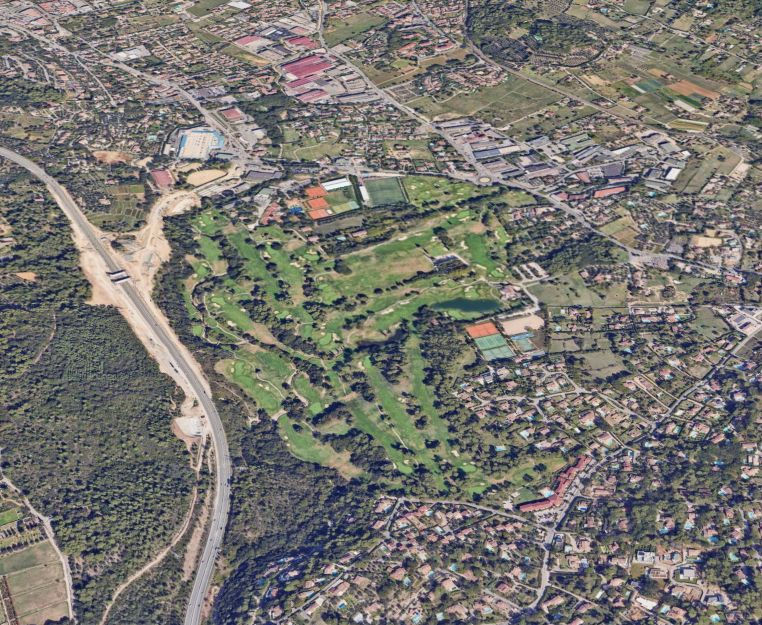
By 1851, he had accumulated enough capital for another innovation. He purchased 40 hectares of land at La Paoute, where he began growing flowers for perfume. ‘La Paoute’ means, in Provencal, ‘the muddy quarter’‡; it was part of the flood plain of the Mourachonne river. Hitherto, flowers had only been grown on small parcels of land around Grasse and were supplied to what were still mostly small artisanal workshops: DJM was the first factory owner to grow flowers on a large scale. Later in the century, such extensive fields were to supply the quantities needed for Grasse’s ‘industrial revolution’ based on steam distillation.
DJM expanded the buildings on the site. He added a water mill, to supply which he built an aqueduct to take water from the springs of the valley to the west.

St Lorette factory
But the Oratory factory had become too small, and one suspects that getting labour to somewhere as remote at the time as La Paoute restricted his ability to expand there, because in 1860, he bought virgin land at St Lorette on the fringes of the old town. There he constructed a new factory to replace the Oratory and went into partnership with a man named Alfred Achille Boyveau. His choice of location was subsequently endorsed when other factories were built close by – Sozio in 1890, Molinard in 1891 and Bérenger in 1908.
The farm-school
It seems that the new factory rendered many of the facilities at La Paoute redundant, because in 1862 DJM created a farm school specialising in flower cultivation. This system, which had been in place since 1848, allowed proprietors like him to set up ‘fermes-écoles’ in which the state paid for the staff and apprentices provided free labour in return for an education, with the owner of the land being the farmer and taking the profits. In the case of DJM, he was probably also the main customer.

The farm-school system was already being cut back before 1862. DJM’s subsequent political career indicates that he might have had good links with the Bonapartist national government which helped him to obtain approval for his specialist ‘ferme-école’.
The school was closed down in 1875 when agricultural education was re-organised nationally under the Third Republic, but by then DJM was dead.
Into politics
Through the1860s, DJM gradually relinquished his power over the business to Alfred Boyveau, during which time he moved into politics. The company name progressed from J Méro in 1861 to Méro & Boyveau by 1867, and in 1870 there was some kind of row between the partners. In 1871, the dispute was resolved by Boyveau leasing the St Lorette and La Paoute premises from DJM. Thereafter, Boyveau successfully carried on the company on his own.

Meanwhile, DJM became in 1861 both a Grasse municipal councillor and a member of the council for the new department of Alpes-Maritimes (for St Auban, north west of Grasse, where his successor-but-one was his perfume competitor Léon Chiris). But then, in 1865, he abruptly changed his allegiance.
Under the Second Empire, maires were appointed, not elected, and in that year he was made mayor of the town of his birth, Cannes, by imperial decree. His Bonapartist connections must have been very strong.
Mayor of Cannes
DJM had made his fortune and his initial foray into politics in Grasse, but Cannes seems to have been where he wanted to be. Even in 1855, when he was awarded the Legion of Honour for his work in perfumery, he is registered as living there. He was mayor from 1865 until 1874, although in the period after Napoleon III’s defeat in September 1870 (during the time of the so-called Government of National Defence and the Paris Commune), his position was distinctly uncertain. He was elected (rather than appointed) again in 1871, still as a Bonapartist, but by then his power was distinctly limited by Republican opposition.
But in the five years from 1865 to 1870, he was instrumental in developing the town. Cannes’s population had quadrupled since 1800 to around 10,000 people. Its infrastructure was under strain, especially because it had become a hotspot for wealthy winter visitors, and the town needed a man of energy and ideas like DJM. He built the boulevard de la Croisette, originally naming it Boulevard de l'Impératrice in honour of the government which had made him mayor. For the benefit of the target population he installed a modern sewage line and created the town’s Grand Jas cemetery. But perhaps most important of all, he was the driving force behind the construction of the Siagne canal system which still supplies water to the entire municipality from the Siagne and Loup rivers.

I have posted about the battle for water between Grasse and Cannes here. The battle was ended when DJM obtained a governmental decree in 1866 giving Cannes exclusive rights to the waters, leaving the town which had made his fortune, Grasse, in the lurch.
Chapel
DJM died in 1874, aged 68. In 1856, he had had a chapel built on his land at La Paoute, which was dedicated to his namesake saint, St Donat, who is said, rather appropriately, to protect crops against storms and fire.
The chapel, now surrounded by the golf course, looks typically nineteenth century – almost a folly, in fact – but it boasts two attractive tiled pinnacles.

Despite DJM’s funeral service after his death in 1874 being in Cannes, he is interred in the chapel, which is just within the commune of Grasse. A fountain and lavoir in the village of Le Plan was built from a bequest in his will.
* I have taken some of DJM’s biography from an article about the Méro and Boyveau company in ‘La Magie d’un Terroir’ by André Raspati (André Raspati and Gabriel Benalloul, Editions Campanile, 2023)
† Cold enfleurage is the classic method by which fragrance is extracted from, especially, jasmine. Fats ground from a mixture of pork and beef are spread on to a wood and glass frame into which flower petals are inserted.
‡ My thanks to Gilles Burois for this and several other contributions during a recent guided walk in La Paoute


Comments