India’s Grasse: a visit to Kannauj
Updated: May 27
Kannauj is a town of around 80,000 people which lies about 400km east of Delhi in India’s largest state, Uttar Pradesh. An estimated 80% of its workforce is involved, directly or indirectly, in the manufacture of perfume. So if Grasse is the perfume capital of the world, Kannauj is definitely the perfume capital of India.

The town
Kannauj itself isn’t much like Grasse. Its site, in the middle of India’s fertile Gangetic plain (the river Ganges is only 5km from the town centre), is, unlike that of Grasse, as flat as a pancake. The nearest significant hill is over 250 km away.
Kannauj is even older than Grasse’s thousand or so years of history. Kannauj’s archaeological museum has artifacts dating back to well before the Common Era, and for over 600 years from the late fifth to the end of the twelfth century CE, it was the capital of various important kingdoms in northern India. Its royal court of the seventh century was sufficiently leisured to have originated a board game named ‘chaturanga’, which is the ancestor of modern chess.
Today, it's just like most Indian towns: crowded and sometimes chaotic, with its streets full of a mixture of people, trucks large and small, tuk-tuks, motor cycles and wandering cows.
Perfume in Kannauj
Perfume has been made in Kannauj for at least five hundred years and probably very much longer, because scents are known to have been used by India's Vedic civilisation, which was active approximately from 1500 to 600 BCE.
In the sixteenth century, Kannauj’s artisans benefited from the arrival from Persia of the Mughals, the most powerful of successive Muslim waves of invaders from the west, who were enthusiastic users of perfume. Six Mughal emperors (the fourth one built the Taj Mahal) established their dominion across northern India between 1526 and 1707, although not entirely without difficulty – the second emperor, Humayan, suffered a big defeat in a Battle of Kannauj in 1540.
Parallels with Grasse
As you drive towards Kannauj, you find yourself surrounded by flower fields, especially roses but also jasmine, marigolds and others. Small buildings are dotted around where the petals of the blooms, harvested by hand at dawn, are collected in sacks and taken to the town by tractor. It’s not difficult to imagine yourself in the flower fields of Grasse at the turn of the last century.

In Kannauj, I recently visited the factory of Pragati Aroma Oil Distillers. The company’s CEO, Pushpraj Jain, represents the fifth generation of management since it was incorporated, but its artisanal origins are certainly centuries older. It employs around 200 people, so equivalent to a large family perfumery in 1900s Grasse.
Like some of Grasse's businesses, the company has expanded from Kannauj, and today employs some eight hundred people in eight factories around India.

The next generation of the family are based at the company's head office, now in Mumbai, and are busily engaged in building a marketing operation for finished perfumes and related products under the brand name of ‘Brew’.
Technology
The Kannauj factory uses both steam distillation and a much older technology of multiple stills over open fires, known as 'deg-bhapka'. Flowers and other materials are distilled in copper vessels (deg) over a wood fire, with the vapour traveling through pipes, which may be copper or bamboo (chonga), to a condenser (bhapka) where it is captured into a receiving oil, typically sandalwood. The bhapka is immersed in a water tank known as a gachchi to cool it.
The temperature is regulated only by building or reducing the fire – no mechanical gauges are involved!

For steam distillation, the factory boasts a chimney which, for all the world, could be in Grasse. They have re-purposed the boiler from a redundant coal-fired steam locomotive to generate the steam used to power the stills used, especially, to extract oil from sandalwood.

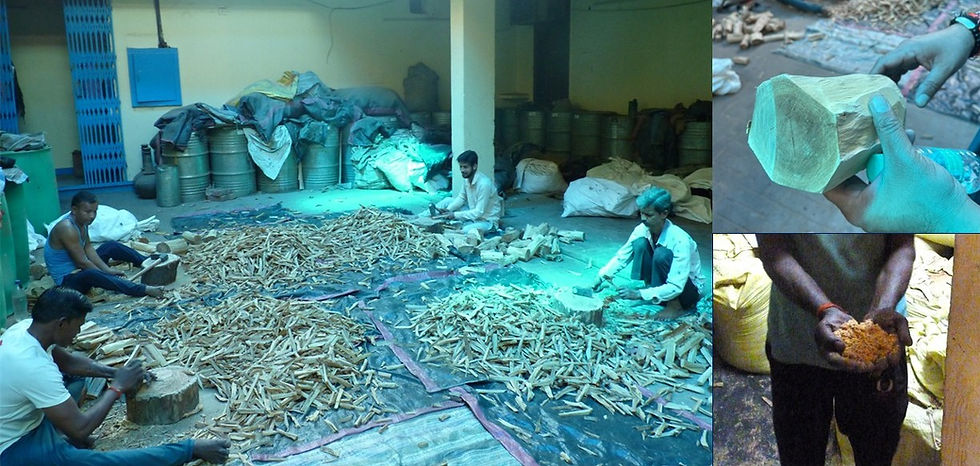
The sandalwood, which is very expensive, comes from southern India. The cultivation and felling of the trees and the movement of their timber is strictly regulated by central government. The core of each section of the tree’s trunk, which contains the oil, is extracted by workers using small axes manually to split away the outer parts. The cores are converted to powder by machine, ready for distillation.
Scents
Some of the factory’s products, notably those related to roses and jasmine, parallel those of Grasse, but others are different.
Ittar Mitti is the scent of fresh rain on dry soil (‘ittar’, originally an Arabic word, refers in Hindi to the products of traditional distillation, which are always oil-based). The scent is known as Petrichor in modern English and it is produced by distilling baked clay cakes.

Vetiver, an earthy and woody scent, is distilled from the aromatic roots of
vetiver, a grass which is related to citronella and lemongrass. One of the most expensive of Kannauj’s perfumes is Oud, sometimes known as ‘liquid gold’. It is distilled from a protective mould produced by the agarwood tree (native to Assam) when it is attacked by insects or otherwise damaged.
Ancillary products
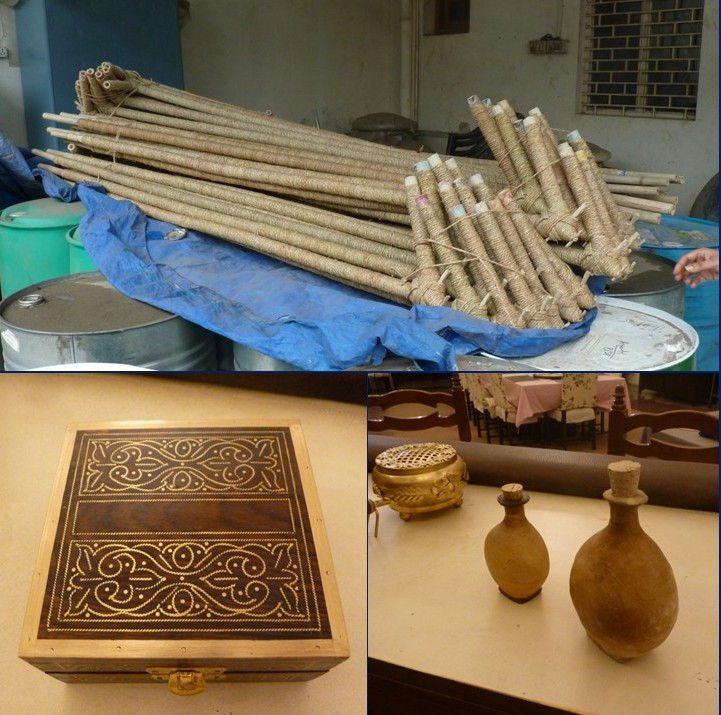
As in Grasse, where the Tournaire company which now manufactures high tech packaging originated as a maker of stills, Kaddauj has a still thriving network of artisans who support or complement the distillers. Some produce the copper vessels and pipes used in deg-bhapka while others make the more traditional bamboo pipes. Those may last only a month but are better for certain flowers.
Perfume bottles, now usually glass, were once made by Kannauj artisans of leather, often from camel skin, which makes a vessel as light as plastic but also slightly air-permeable. They helped to mature the contents by allowing slow evaporation of the water content.
Beautiful display and storage boxes are still made in local workshops of wood with inlays of copper wire.
Industrial development and politics
About 15km outside Kannauj, and directly abutting the modern six lane highway from Lucknow to Agra and Delhi, lies a rather forlorn looking incipient industrial park. It might by now have become Kannauj’s International Perfume Park & Museum if things had gone to the original plan. The aim was to establish a skills development centre, which would be a magnet to incoming perfume manufacturers wishing to build their natural perfumes credentials by producing in Kannauj.
The ambitious project was initiated under the Uttar Pradesh state government when it was controlled by socialist Samajwadi party, but in elections of 2017 the Chief Minister of the state was ousted by the BJP – the Bharatiya Janata party, which is led by India’s prime minister, Narendra Modi.
The BJP cancelled the project. It seems that political influence is as essential in developing Kannauj industrially as it was in Grasse in the nineteenth century (see my blog here)!

Want to visit Kannauj?
Kannauj is easy to reach from the state capital of Uttar Pradesh, Lucknow (which itself is well worth a two or three day city visit), being 120km away along a fast and fairly deserted road. My wife and I had a two-day homestay (if you can call staying in a small palace such a thing!) at Anand Bhawan in Tirwa, roughly 10km from Kannauj. If you have the chance to go, Shruti Shandilya and Divyaudit Singh will make you very welcome.


Comments