Industrial Grasse
Updated: Apr 10
Grasse has always been an attractive town, with a great climate, wonderful views right down to the Mediterranean and perfumeries producing alluring products in an unpolluted environment, yes? No ‘dark satanic mills’ here, right? Well, actually…no!
Today, most visitors don’t notice the perfume plants because they are both modern and well away from the old centre, but, a century ago, Grasse was very evidently an industrial town. And the owners of the perfumeries in the nineteenth century seem to have been proud of it. If you look at their publicity material, it’s striking how many show chimneys emitting lots of dark smoke.
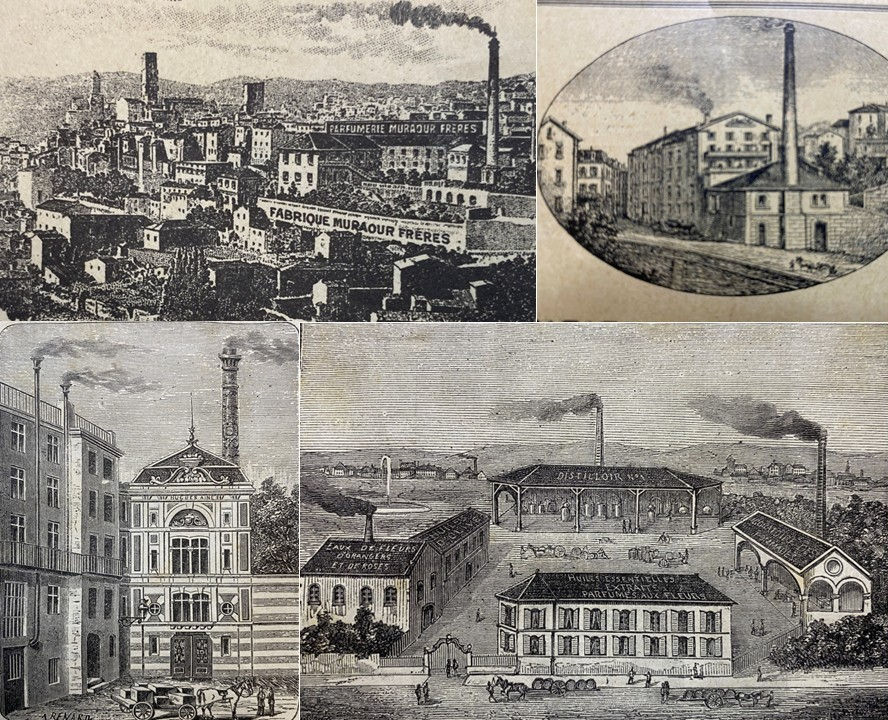
In his book about the 1920-1940 period in Grasse, Emile Litschgy*, who was the son of one of the town’s major hoteliers, tells us that “each factory naturally had its own steam engine, belching out…thick, black smoke” and most “produced powerful and prolonged roars”.
So what was it really like in Grasse at the turn of the last century?
Coal and the chimneys
Steam distillation revolutionised Grasse’s perfumeries from the 1870s onwards. And it necessitated the installation of boilers all around and in some cases inside the old town. With that came a need for coal to fuel the boilers. Fortunately, starting from 1871 there was an efficient way to get it here by rail to the new PLM (Paris-Lyon-Méditerranée) station in the valley below (and later to the long-gone Gare du Sud via a narrow gauge line from Nice opened in 1881). Coal in sacks was unloaded and taken by horse-and-cart to the waiting factories.

The coal came from mines at Gardanne, conveniently located only 25km or so north of Marseille, and horrid stuff it was too – black lignite, with a high sulphur content, dust-generating when moved, and having a nasty tendency to self-combustion.

No doubt it was much cheaper than relatively clean anthracite steam coal from northern France. It's not surprising that the factories produced so much black and smelly smoke.

Soap
Grasse’s other important manufactured product was soap, the making of which requires a fat (olive oil, in this case) and an alkali (typically soda ash), plus an ample supply of water both for production and to take away the waste. Soda ash had once been brought into Grasse from artisan sources at the coast, but after Ernest Solvay invented his eponymous chemical process in the 1860s, cheaper supplies could come in, and efficiently by rail at that.
Soda ash is a nasty chemical. Left in storage for long, it damages buildings, never mind people. And the waste water from using it in production carries materials which are strictly controlled in modern times, but which certainly got into the Grasse’s water supplies downstream. In 1877, there was a lawsuit between the largest soap manufacturing family, the Latils, and their neighbours in the Riou Blanquet valley over contaminated water. There seems to have been no result: perhaps such a modern problem was beyond the court’s competence to resolve.
Solvents
By 1900, steam distillation for perfume had been supplemented by chemical processes – the use of solvents, such as hexane and ethanol, for extraction. Like coal, the chemicals were brought from the station to the factories through Grasse’s streets, in carboys (glass vessels packed in straw).
The dangers of such products to human health were at least recognized in the building of ventilated halls like the ‘mosquée’ of Antoine Chiris, but would you want to be living in an area where noxious chemicals were being carried by cart and flammable and hazardous fumes vented?

Noise
Emile Litschgy describes not only smoke but noise. He says “the sirens of our factories that ruled the people of Grasse... and early in the morning, the entire town was awakened by their cacophony”, and this on top of the noise of the production processes themselves. One visitor picks out Chiris in particular: “More strident than the others, the Chiris factory siren always dies last...”
Housing
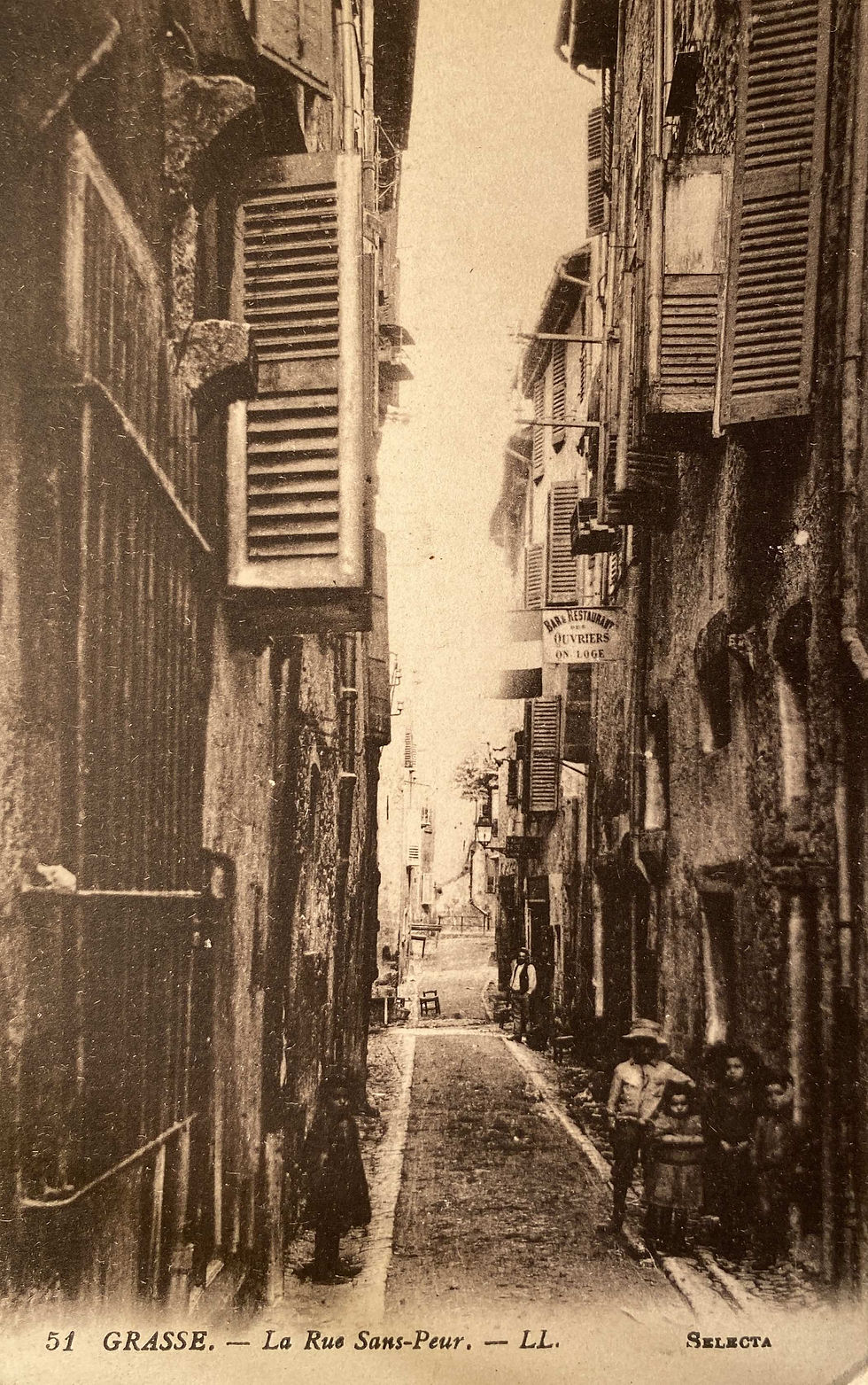
Like all industrial populations of the nineteenth century, Grasse’s workers needed to be close to the factories. So, willy-nilly, many were crowded into the insalubrious housing and inconvenient alleys of the old town. A few streets were so poor that they were demolished after the second world war, but contemporary postcards show that some of Grasse’s streets looked just like those of the industrial towns of northern Europe, although on a much smaller scale.
At least, in the 1920s, Grasse joined the trend of some enlightened employers towards modern company housing for some workers. You can read my post about Grasse’s company housing here.
Grasse, the resort
The second half of the nineteenth century saw the emergence of Grasse as a winter resort, with numerous hotels and pensions opening, especially along the new road (av Thiers and av Victoria) to the east. Hivernants (winter-residents) came in their droves.
The attraction was the sunshine and the clean air of the edge of the mountains, easily accessible from the new railway from Cannes, and the presence of industry did not inhibit the incomers. Perhaps the prevailing winter winds, from the west and north west, helped to protect the visitors from polluted air and noise, but it certainly did not stop them and their hosts from complaining and taking the factories to court. Emile Litschgy says that “photographers, to illustrate the lawyers' arguments…capture on film the monstrous plumes of black smoke rising into our sky” but that Grasse’s “industrialists were proud. They resented the existence of an activity beyond their control, and to clearly demonstrate their supremacy in the city, they had no scruples or restraint in disturbing the stay of these convalescents.”
Hoteliers and perfumers seem eventually to have settled on an uneasy truce.
Ghostly remains
A few surviving industrial chimneys are dotted around the environs of the old town. No doubt the chimneys owe their survival to its being more expensive, on fairly cramped sites, to demolish than preserve them. It doesn’t always apply, as this photo from 2002 graphically demonstrates!

This map shows Grasse’s chimneys which still exist today:

The Sozio and Bérenger Jeune factories, originally built on agricultural land, date from 1891-1906. Both closed in the 1990s. You can see more about them in my ‘hidden perfumeries’ post here.
The Fragonard building dates from well before it attracted that name. It was built for the perfumer Fargeon in about 1840 and was bought by Eugene Fuchs, who re-branded it as Fragonard (whom I have posted about here), in 1925.
Robertet moved to their site on avenue Sidi-Brahim in 1897. The name is rather misleading: the company has actually been managed and, since the 1920s controlled, by the Maubert family. Along with Mane, it is one of Grasse’s two great family managed fragrance and flavours enterprises.
The Roure-Bertrand complex, which originated in a religious building, was closed in 1998 but good management on the part of the town has meant most of the site's historic buildings have been retained, re-used and look very impressive.

By contrast, the Muraour site, now used as a depot by the town, looks thoroughly decrepit. By then owned by the Cauvi family, it closed in the 1980s, although not before the Cauvis in the mid-1960s built a new steam generation plant to supply several perfumeries in the immediate area. That’s why there is a 70 metre modern chimney there, close to the station.

It would horrify most people if they had to live now in old-fashioned factory towns, but Grasse was once one of them. Much of it is quite charming today, but the record of its industrial past is still visible.
* ‘En ce temps-là’, Emile Litschgy, Editions TAC Motifs, 2002


thanks for your efforts & sharing