Six artists in war-time Grasse
Updated: Mar 1
From July 1940 until November 1942, Grasse was part of the ‘free’ zone of France, governed by the Vichy regime. The zone was attractive to French people, especially those of Jewish origin, wanting to leave the occupied area and the regions annexed to Germany in the north.
Six significant artists took refuge in Grasse at the time, although not all were French. They were Sonia Delaunay, Jean (originally Hans) Arp and his wife Sophie Taeuber, Alberto Magnelli, Ferdinand Springer and François Stahly. Before the war, Delaunay, Arp, Taeuber and Magnelli were all members of a group of artists in Paris known as Abstraction-Creation, alongside Sonia’s husband Robert Delaunay, Wassily Kandinsky and Piet Mondrian.
How did they come to be in Grasse?
Alberto Magnelli owned a small estate on the Le Plan de Grasse, named ‘La Ferrage’, and he and his wife went there in October 1939, shortly after war broke out.

The Arps wrote and asked if he could recommend a nearby villa and he found for them Chateau Folie, in the St Jacques quarter. Then, it would have been just below the Chemins de Fer du Sud railway line, now av Mistral. The house has long gone, engulfed by a modern development which nevertheless retains the name.

In the same year, the Delaunays took an apartment in Mougins, but they later went to Montpellier, where Robert died in 1941. Sonia returned to Grasse and lived first at Chateau Folie with the Arps and then in the Grand Hotel.
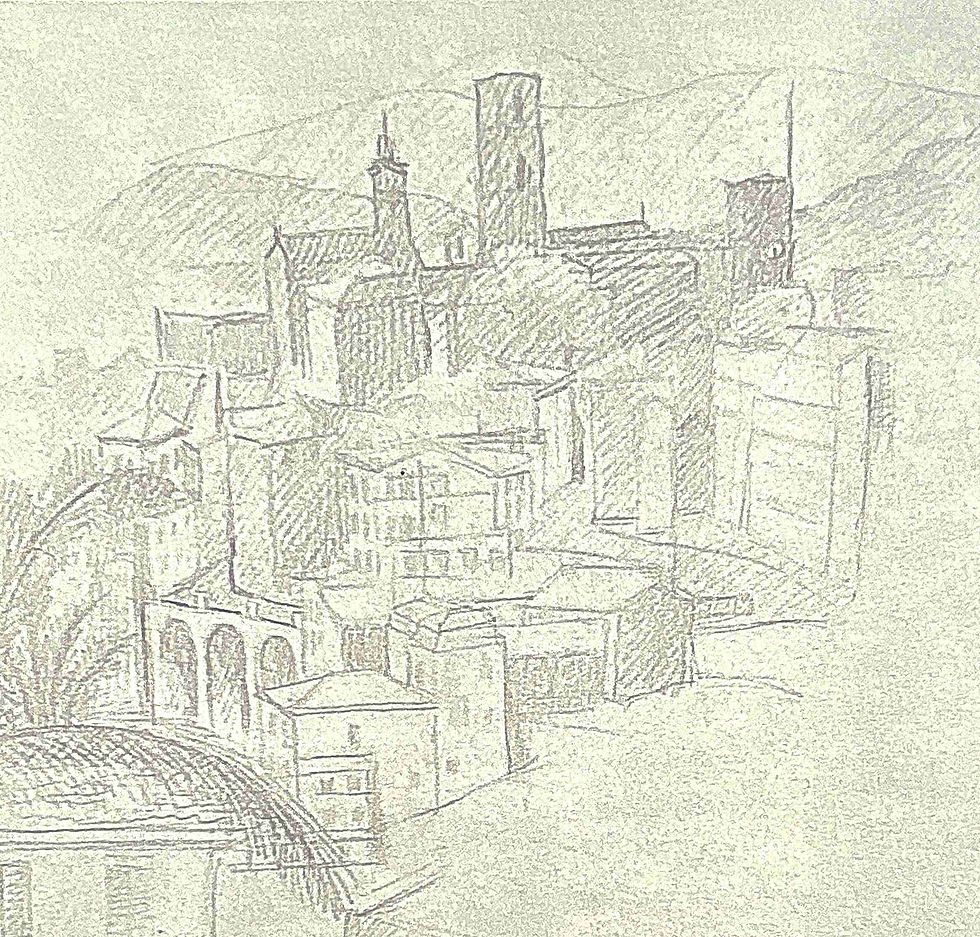
In her autobiography, Sonia Delaunay writes of "a house surrounded by olive trees with a view which extends to the sea". Since it is impossible to see the sea from La Ferrage and it was surrounded by flower fields rather than olives, obviously she must mean Chateau Folie. She also describes, while living in the Grand Hotel, seeing a round-up of Italian soldiers by the Germans, which would have been in September 1943. After that, the hotel proprietors apparently found her a villa nearby which is not identified.
Ferdinand Springer had arrived in Grasse in 1933 at the age of 25, influenced, like so many artists, by the light of the Cote d’Azur. As a German national, when war broke out he was interned in a camp in Aix-en- Provence, where he met Max Ernst and other artists. Later he worked for the French army, but was released to return to Grasse in 1940. François Stahly, who was partly German, avoided internment but spent most of 1940 eking out a peripatetic existence. Influenced by an acquaintance with Springer, Stahly rented a small house in 1941 in the St Jean-Malbosc quarter of Grasse with his wife, who was a designer, and family.
The Arps, Magnelli and Sonia Delaunay seem to have worked most closely with each other, but all six met regularly on a Saturday at a brasserie named Bianchi, which was on the Cours Honoré Cresp. Together, they formed a short-lived ‘Grasse Group’ of artists.

Their work in Grasse
Under wartime conditions and with money very short, artistic materials were not easily available. Some of the artists' work is identifiable with what they were making before the conflict, but they also created small pieces from whatever was available, especially collages. Arp probably first started to use ‘papiers froissés’ (‘crumpled papers’), which became a significant part of his later work, at Chateau Folie.
In her autobiography, Sonia Delaunay writes that "our small group formed an island of peace and friendship that created an atmosphere conducive to work". They exchanged pieces within the group: "they were our only customers and collectors".
The Arps, Magnelli and Delaunay collaborated on the production of gouaches (water colour paintings which are similar to acrylics or oils) from which a sequence of lithographs was eventually published in 1950 under the title ‘Album de Grasse’.

In these compositions, one of the artists starts with an initial motif which another develops by drawing on the same sheet of paper. The result is a series of complex images. Sonia Delaunay recounts hiding these and other works in a cellar until 1945, although many did not survive the war.
The Artists
Sonia Delaunay was born in a Jewish community in Ukraine in 1885, but she was brought up by her well-off uncle in St Petersburg. She became a French citizen through a marriage of convenience in 1908. In 1910 she re-married the artist Robert Delaunay. They worked closely together, but, from the 1920s on, her focus moved to clothing and costume design. Much of her time in Grasse was spent cataloging her deceased husband’s work. She identified strongly as Parisian and French and appears to have completely discarded her Jewish origins, which must account for her almost insouciant attitude to the Vichy, Italian and German regimes in Grasse.
Hans Arp was born in Strasbourg to a French mother and a German father in 1886 when it was part of Germany. He was legally re-named Jean Arp after World War I when Alsace became French again.

He was known as a Dadaist and Surrealist and exhibited alongside Matisse, Robert Delaunay, and Kandinsky. He married Sophie Taeuber in 1922.
Sophie Taeuber-Arp (1889-1943) was a Swiss-born artist, painter and sculptor, and in her younger days an outstanding dancer. Like the Delaunays, she and her husband Jean worked together, but she was also a modernist designer of furniture and for the theatre. Her work from as early as 1915 included squares and rectangles like that of Mondrian and Paul Klee.
Alberto Magnelli was born in Florence in 1888 and as early as 1909 was shown at the Venice Biennale. His work is said to be abstract style with cubist and futurist elements. In the 1930s he went to Paris to avoid the Fascist regime. His wife, Susi Gerson, was Jewish.

François Stahly was born in 1911 of Italian and German parentage. Brought up in Switzerland, he worked in Paris until 1940 and was naturalized as French. That was withdrawn by the Vichy regime, but he must successfully have hidden his origins while in Grasse. According to his autobiography, he didn’t do much sculpture at the time, making collages and producing buttons and buckles designed by his wife, but some of his pieces in wood do survive.
Ferdinand Springer: an adopted Grassois
Springer was born in Berlin in 1907. Apart from Alberto Magnelli he was the only member of the group to have been in Grasse before the war and was the only one to live and work here thereafter. His wife was Jewish and, like the Arps, he managed to flee to Switzerland when Vichy fell in late 1942. He went back to France in 1945, first to Grasse and then to Paris, but from 1960 lived mostly in Grasse, where he had his home and studio in the St Francois quarter.
While not a member of the Abstraction-Creation group, Springer was best known, after as well as before the war, as a painter and printmaker of abstract and geometric shapes. But his later work, currently exhibited in the Musée International de la Parfumerie here in Grasse as ‘Imaginary Landscapes’ (‘Paysages Imaginaires’), is quite different.
The images are based on landscapes around Grasse, especially Caussols, and as far away as the Mercantour, but they were painted in his studio and can only rarely be related directly to anywhere specific. But since, like him, I live in St Francois, I was struck by one large watercolour entitled ‘Falaises’ (‘Cliffs’). His house was on the Chemin des Basses Ribes and this image is surely influenced by the cliffs at the top of the ‘cirque’ of St Francois.

Springer died in Grasse in 1998.
What happened to the other artists
The southern zone gradually became more dangerous to anyone of Jewish origin, culminating when the Germans occupied Grasse in September 1943 after ten months under the Italians.
Jean Arp and Sophie Taeuber took refuge in Zurich, where Sophie died accidentally of carbon monoxide poisoning at the age of 54. Between 1995 and 2021, her photograph, along with an image from one of her works, 'Tête Dada' from 1919, appeared on Swiss 50 franc banknotes (Alberto Giacometti was on the CHF100 ones). In 2021, an exhibition of her work, including embroideries, sculptures, puppets and Dada objects as well as paintings, took place at Tate Modern in London.

Jean Arp continued his pre-eminent career as a painter, poet and sculptor, dying in Switzerland in 1996. No less than three foundations hold and commemorate his work, often alongside that of Sophie.
Alberto Magnelli retained La Ferrage after the war as a summer home, but his very successful career was based in Meudon, outside Paris. He died in 1971. His work is shown in major museums world-wide, including locally in the Fondation Maeght.
Sonia Delaunay spent much of her life post-1945 in establishing Robert as a first rank artist, but she exhibited her own work and created illustrated books. Her paintings are mostly in the Pompidou, the Musée d'Art Moderne in Paris and the Museum of Grenoble, but are also exhibited in other museums around the world.
François Stahly went to Normandy in 1943. He set up a workshop in Paris in 1949 and later worked and taught in the USA. He was another post-war success. Many of his pieces can be seen publicly in France and elsewhere. He received various prestigious awards before dying at the age of 95 in 2006.
*I am indebted to 'L'Art Retrouvé', Marie-Christine Grasse, Parkstone 1997, for the illustrations marked with an asterisk.


Comments