How Italians helped to shape Grasse
Updated: Jun 27
The ‘free movement of peoples’ is a fundamental tenet of the EU today, and was a very significant factor in the UK’s voting to leave the Union in 2026. Yet restricted movement between European countries is actually a fairly modern phenomenon.
For many centuries, constraints on people moving around were generally local. Lords and other dominant figures tried to keep the labour and skills which they needed close to them, with variable success. It was only in revolutionary and then Napoleonic times that national controls were established. Then, in the 1860s, there was a wave of decisions, including in France, to abolish passports altogether. Workers could obtain a certificate of good character from their mayor to help them to move and find work. Only in 1914 were the draconian requirements for documentation which we know today re-established.

So for much of history, there has been little to prevent the movement of people. Grasse in particular has been a major beneficiary of economic migration from what is now Italy.
Chain migration
In the UK, we’re quite familiar with the idea that migrants from a given region tend to cluster in certain cities (those of Pakistani origin in Bradford or Punjabis Sikhs in west London, for example), but in reality migration has often been even more specific. So while people of Gujarati origin represent a significant proportion of the population of Leicester, many of them originate specifically from Surat, in the south of Gujarat state. And while there is a big Greek community in Melbourne, Australia, a large proportion originate more precisely in the Laconia region of the Peloponnese.
Sociologists call the mechanism involved, in which migrants follow family, network and friendship connections ‘chain migration’. So, it’s not surprising that the process applied during several surges of migration into Grasse from Italy.
From Albenga after the Black Death, 1480-1530

Despite the Covid period, we have (thank goodness!) no experience today of what a major pandemic does to an entirely unprotected population. Successive waves of the Black Death in the fourteenth and fifteenth centuries reduced the European population by between one third and a half. Grasse was no exception. Based on lists of households (compiled for tax purposes), its estimated population of around 7,000 in 1430 dropped by 1480 to less than 3,000. Nearby villages such as Cabris, Auribeau and Opio were wiped out completely. Recovery was slow, but Grasse’s tanning industry was a magnet bringing emigrants in from Liguria and Piedmonte.
A historian named Françoise de Person wrote her doctoral thesis on movements of population in Grasse in the sixteenth century. She found marriage and apprenticeship contracts showing that tanners from the Ligurian municipality of Albenga in particular established themselves in Grasse.


They married into local families and brought relatives and apprentices here from their home town. Names like Cresp (then Crespi) and Pérolle (Perolla – ancestors of the person who gave Grasse its paintings by Rubens) appear to derive from Albenga. Tanning was a major industry there as well as here, but being right on the coast it was much more vulnerable than Grasse to military and slave raids from the sea.
As a relatively large scale manufacturing trade, tanning could pay ordinary workers more than could agriculture and Grasse offered experienced tanners better prospects if they moved. The town also offered small plots of unoccupied land nearby to raise domestic crops, while the similarities between Provençal and the Ligurian or Piedmontese dialects meant that language was not a big barrier.
By 1530, Grasse’s population had recovered to over 4,000.
From Sanremo, 1580-1630

The late sixteenth and early seventeenth centuries saw the gradual emergence in Grasse of glove making, a trade which added significant value to its tanning business and which also drove the development of perfume. According to a plaque on a medieval building in the Traverse des Soeurs, Catherine dei Medici stayed in Grasse on her way to her marriage to Henri III of France and brought with her the concept of perfumed gloves. That’s probably complete nonsense (indeed, there is even evidence that a different Catherine dei Medici was responsible!) but there seems little doubt that an influx of Italian artisans who accompanied France’s links to Renaissance Italy indeed brought with them new expertise in food and perfume.
At this time, migrants frequently came to Grasse from Sanremo. In both Grasse and the departmental archives, there are marriage contracts involving men from Sanremo marrying the daughters of Grasse tanners or glovemakers and naturalisation contracts where tanners or glovers are shown as originating from there.

The attraction was probably the newcomers’ knowledge of sophisticated tanning and distillation techniques based on Sanremo’s expertise in processing bigardier (bitter orange) and other citrus sources such as lemon and jasmine. Slave raiding from the pirates of the Barbary (Algerian and Moroccan) coast was still a ‘push’ factor away from the Ligurian coast.
From Roccabruna into industrial Grasse, 1870-1914

Much the largest influx of Italians into Grasse came during the town’s industrial perfume zenith in the fifty years before the Great War. Its population in the 1911 census was 19,700, of which no less than 5,900 were Italian, a scarcely believable 30%. A Professor of Economic History at Turin university named Renata Allio in 1984 published a study of what happened.

Roccabruna is a small group of villages in the Maira valley, about 25km from the city of Cuneo in Piemonte. It’s around 200km from Grasse, in a mountainous area 2,000 metres above sea level. In the later nineteenth century, it, like much of the province of Cuneo as a whole, was both poor and over-populated.
By contrast, Grasse was a boom town. The population had risen from 12,000 in 1850, driven by the need for workers in the perfume fields, the perfume factories, the hotels accommodating the ‘hivernants’ (rich winter residents) and the construction of new buildings for the perfumiers. Grasse’s industry needed males and females, the young and the middle-aged.
France also had a problem with a low birth rate, which was 30% lower than in Italy. This was a major concern of the military of the time, concerned about a potential lack of cannon-fodder in potential wars with Germany, Italy and Britain! And there was an existing tradition in the mountainous areas which made up much of Cuneo province of seasonal movement for work. For a not fully explained reason, a popular trade was in anchovies in Liguria and Savoy.
All these conditions conspired to generate a huge influx of Italian families into Grasse from the Cuneo countryside in general and from Roccabruna in particular. According to Allio’s research, seventy percent of the town’s Italians in 1911 originated in Piemonte, the vast majority from Cuneo province. This table, taken from the local labour register for 1885-1898 in Grasse's archives, shows the details of seven incomers: they were clearly crucial for the perfume factories.
Name | Where born | Age | Employment | Employer |
Degiovani, Anna Marie | Roccabruna | 34 | Journalier (day labourer) | Mr Roure |
Georretti | Roccabruna | 23 | Journalier | Mr Isnard parfumier |
Belliardo, Angelo | Roccabruna | 27 | Journalier | Mr Piver parfumier |
Anselme, Anne | Roccabruna | 19 | Journalier | Mr Auzier parfumier |
Rebuffo, Marie | Roccabruna | 18 | Journalier | Chiris |
Casassa, Marie | Roccabruna | 16 | Journalier | Lautier fils |
Isoardi, Rose | Roccabruna | 20 | Journalier | Lautier fils |
There were 250 immigrants in all from Roccabruna, which was 10% of the entire population of that commune, far higher than any other part of Cuneo. The poverty-stricken valley of the Maira, of which Roccabruna is part, in all accounted through chain migration for over 650 of Grasse’s Italian immigrants.

From Rizziconi in the flight from southern Italy 1920-1960

Grasse continued to exert its economic pull on Italy after the Great War, with a continuing flow of immigration from Piedmont and Liguria being augmented by families from Umbria, especially the area around Lake Trasimeno. But the town’s population rose only slowly (in 1930 it was 23,000) and naturalisation and children of immigrants being registered as French rapidly reduced the percentage identified as Italian.
Then after the second war, and during France’s ‘thirty glorious years’, the population rose substantially and one source of newcomers was southern Italy, especially Calabria.
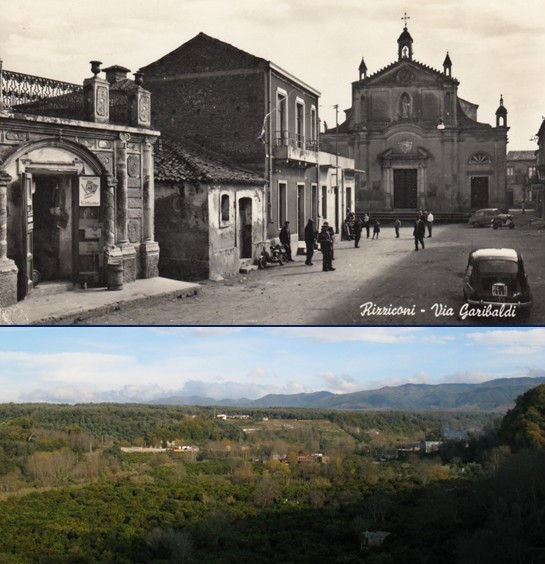
Rizziconi is a small town in a heavily agricultural plain known as the Gioia Tauro, lying 50 kms north of the provincial capital Reggio Calabria. Today it is the location of Italy’s largest container port, but the area has a rocky industrial history dating from the 1970s involving a huge failed steel plant and mafia-type domination of the local economy. Well before then, it was part of the movement of workers from the impoverished but populous south of Italy to the north and beyond, and the chain migration process brought immigrants from Rizziconi to Grasse in particular.
Unlike Albenga and Roccabruna, there is no academic study of what happened and no way of finding who started off the chain process, but in the 1936 Grasse census, you can see many entries for people originating in Rizziconi.

Names including Anastasi (which is Greek by origin), Bonsaudi, Condometti, Laversa and Folimero originate from the Gioia Tauro. Many of the census records for working men cite the occupations ‘manouvrier’ or ‘journalier’, indicating unskilled day labourers in construction and agriculture (probably especially the flower harvest). As with the immigration from Roccabruna, one of the attractions was without doubt the availability of work for both genders, with the women in the harvests and the factories.
Significance of Italian migration to Grasse
So the many Italian names on our war memorial, the shop names which could be Italian or just the Italian-sounding names in local directories are strong evidence of Grasse’s complex past.


Excellent! I appreciate this informative post on examples of economic development. It provides practical illustrations of key concepts. For leaders driving local growth, the premier strategic planning for economic development course & workshop for managers in Rome, Italy provides the tools to create sustainable and inclusive economic strategies...
What an interesting story this is Tom. Over the years these kind of labor movements were common and unfortunately still are. The lesson is to create workplaces in the pursuit of regions and hopefully it will be manageable for them. Best Kees