Grasse’s problematical La Roque
When the medieval architects designed Grasse's walls, they were able to use the steep topography on the east of Grasse’s promontory as a substitute for ramparts in two places. One was immediately below the prominent hill (the 'Puy'), where the cathedral now stands, and the other at the cliff of La Roque 200 metres or so further north.

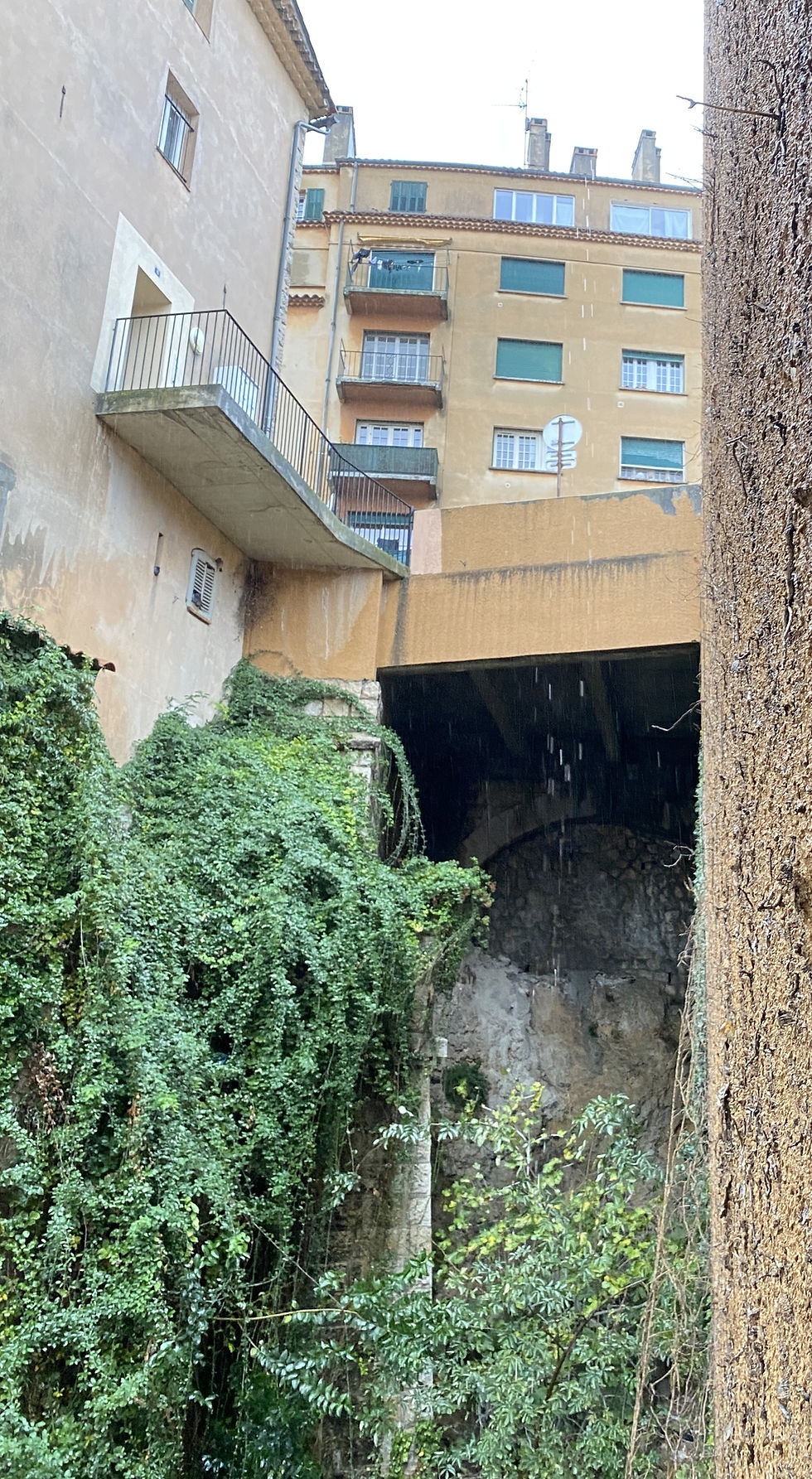
When the unruly inhabitants of the rue Sans Peur (immediately behind the buildings in the photo above) supposedly saw off the Savoyard army in 1708 (see my post here), their position at the top of an unscalable bluff must have given power to their elbows!
The fourteenth century walls were gradually demolished as advancing military technology made them obsolete. As in virtually all medieval towns, streets were built on the old defensive ditches outside and the walls themselves were replaced with buildings of various kinds. Even below the cathedral (today designated bd Fragonard but previously known as Place Neuve) the topography easily allowed the development of a wide thoroughfare.

Not so at La Roque. It stood stubbornly in the path of any road, and one can see in the map of 1788 that the only way of getting along Grasse’s eastern corner was to enter the walls sharply uphill via the Porte Neuve and exit down again via the Porte de la Roque:

Very inconvenient, especially if you were carrying goods which were subject to town taxes. Even so, it was as late as 1884 that the city fathers eventually penetrated La Roque and built a viaduct along the cliff.
The arches of the viaduct are very prominent on all images of the town taken from the east from then on:

Then came the occupation of the town by the Germans, following the capitulation of Italy to the Allies in 1943. They have been unfairly blamed for various acts of destruction (for example, of the funicular, which had gone out of use in 1938) but there is no doubt that the departing soldiers quite gratuitously blew up the Roque viaduct when they left in 1944, leaving the access as it had been in 1884. It was an obvious post-war priority to re-build it, a task which was completed in the late 1940s. But, unlike the old viaduct before the second war, it cannot be seen now, being almost completely hidden by the La Roque car park.
Car parking
In the seventies and eighties, towns across France (and all over western Europe, for that matter) engaged in a sometimes desperate drive to build car parks close to their centres in an attempt to defend themselves against competition from out-of-town shopping centres. In 1960, roughly 5 million private cars were in use in France. By 1980,that had more than trebled to 18 million. Most of their drivers wanted to use them for shopping and that meant parking their cars close by!
But in 1960, the only car park available to the public in Grasse was on the Cours Honoré Cresp – and not today’s three underground levels, just on the square on the top level.

So between 1960 and 1985, Grasse built the Cours, La Foux, Notre Dame des Fleurs/Martelly and Hotel de Ville parking. On the far eastern side, the La Roque car park, along with some social housing blocks, was completed in front of the cliff and the viaduct in 1975.
Given the speed at which these developments took place, it’s hardly surprising that not everything worked. Most notably, the Martelly quarter, which replaced the old Franciscan priory which had been the Bruno Court perfumery, is currently being largely re-built.
But the La Roque development, while much less of an eyesore than the Martelly complex, still doesn’t work well. The car park is tall and narrow, with no less than 24 floors which have to be negotiated by all of its users. It has a single small passenger lift and, worst of all, the user is faced on leaving it with what amounts to a blank wall with no obvious entrance to the old town:

The effect has been that the eastern side of the old town, especially in the fifty years from 1960, has been hollowed out – exactly the fate which the city fathers, in constructing all those facilities, had feared. The Cresp car park presents a relatively attractive entry to the town from the south west, while the La Foux and Notre Dame des Fleurs/Martelly car parks to the west and north are also much to be preferred to La Roque.
So what had once been a vibrant shopping district at the lower end of the rue Droite and on rue Charles Nègre became virtually deserted.

In effect, the centre of gravity of the old town has moved north (Place aux Aires) and south west (Musée International de la Parfumerie and rue Jean Ossola), leaving the east bereft.
An innovative solution – will it work?
As Grasse has been recovering from some of the neglect of the late twentieth century and the first decade of this one, there are signs of renovation to the east. The rear of the Médiatheque development has renovated parts of the streets and the Chapelle Saint-Michel on the top of La Roque was attractively restored in 2020. Recently one or two shops, notably a smart branch of Soli-Cités, have opened on rue Droite and last year the restaurant Roses et Mets appeared a little further down the street.
Now almost complete is a new direct access from the La Roque car park. In the words of Roald Dahl, a ‘great glass elevator’ has been erected on the side of the building. It leads to a bridge across bd Gambetta to the lookout point of place du Pontet, just below the Chapelle Saint-Michel. Although the interior of the car park remains its rather inconvenient self, the pedestrian exit on to the forbidding side of bd Gambetta can now be avoided and the views from the glass elevator and bridge will create a new experience for users.

Above all, the new exit debouches directly on to one of the streets of the old town and one can hope that new businesses along the rue Droite and even rue de la Pontet will follow.
The architects involved are STOA, led by Mariane Rouge and based in Marseilles, who seem to have a good track record in urban design. The town can only benefit if such an original conception as this ‘passerelle de La Roque’ turns out to be successful.


Great stuff, Tom! It brings it all alive.
The before and after photographs are wonderful. Keep 'em coming please.