Ivan Bunin: an acclaimed Russian writer in Grasse
Updated: Jul 18
In the Jardins de la Princesse Pauline, high above our town, stands a small monument to a great Russian writer, Ivan Bunin*. And just like the princess, whose statue is in the Le Jardin des Orangers of the Musée International de la Parfumerie, he has a second memorial in Grasse, at our heritage library at Villa Saint-Hilaire.
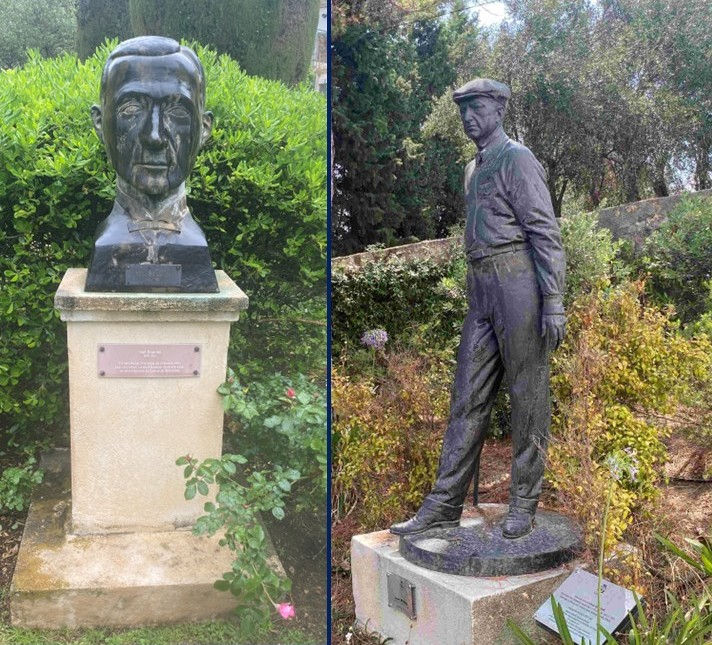
But in terms of what each achieved in their lifetimes, there's no doubt which of them is the more distinguished former resident.
Bunin is generally regarded as one of Russia's greatest writers, if not quite in the league of Pushkin and Dostoevsky, very much a member of the next tier. And he wrote the book regarded as his masterpiece, and for which he was awarded the Nobel prize for Literature in 1933, while living here in Grasse. It’s called ‘The Life of Arseniev’†.
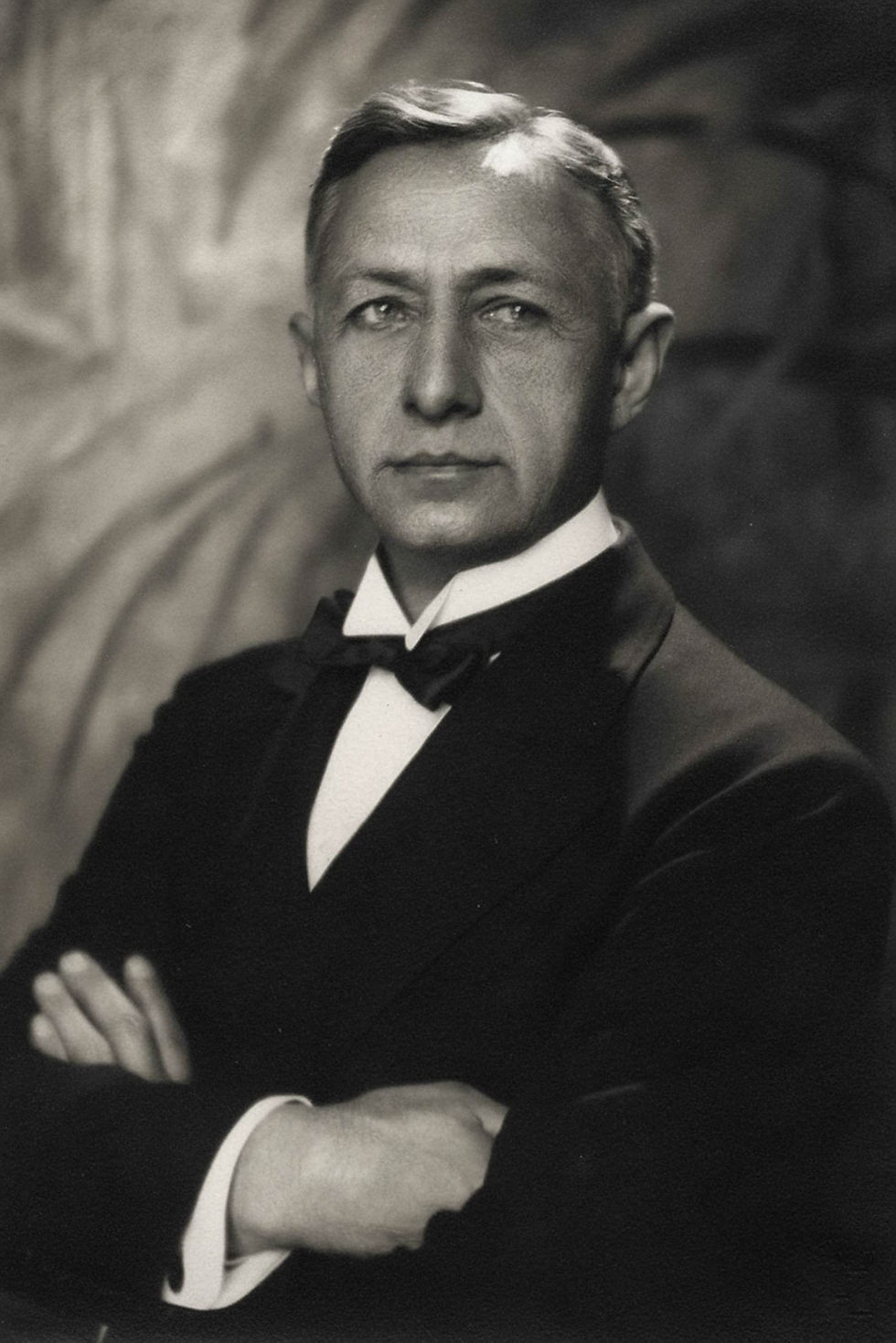
The book is of a genre known technically as pseudo-autobiography. Ostensibly fiction, it is really autobiography, with a few adjustments for the author’s convenience (in the book, for example, the author kills off his first lover, but in reality she married someone else). For practical purposes, for ‘Arseniev’, we can read ‘Bunin’.
Bunin’s life in Russia
Bunin was born in 1870 into landed gentry in Voronezh, a town about 600 km south of Moscow. From the age of 4, he was brought up on two agricultural estates owned by his father. The family was said to be relatively poor, but it’s not clear whether this was a natural condition or one caused by his father's overspending and gambling; certainly the region was and is agriculturally rich.

Bunin was sent to school in another town not far away, in a gymnasium which followed western educational principles. He learnt French and German (and if Arseniev is to be believed, also taught himself English) but above all his childhood and schooling seem to have been steeped in Russian literature.
His first published poem appeared in a St Petersburg literary magazine when he was only seventeen and working in a local newspaper office. Travelling around southern and western Russia, he met and befriended Gorky, Chekhov, Tolstoy and many other contemporary writers. Following the publication of several books of poetry in the 1900s Gorky described him as 'the first poet of our time’, and in 1898 the Russian Academy awarded him the country’s highest literary honour, the Pushkin prize.
He was able to travel extensively, not only within Russia but also to the Middle East, Sri Lanka and the Mediterranean. By 1910 he was widely recognised for his prose as well as his poetry. One of his stories ‘The Gentleman from San Francisco’ was even adapted into English by, of all people, DH Lawrence.
Then, of course, came the Revolution. Bunin's diary of the years 1918–1920, named 'Cursed Days' was published in 1924.

He was in Moscow in 1918 but was allowed to leave, initially to Kiev. Then via Odessa and Istanbul he travelled to Paris in 1929, never to return to his native land. He retained a home in Paris but spent much of his time in Grasse, mostly from 1923 until 1939 in the Villa Bélvèdere, high on the Malbosc hillside which had been part of Alice de Rothschild’s garden.
‘The Life of Arseniev’
The first four (short) books of ‘The Life of Arseniev’ were written and almost obsessively re-written between 1927-1929, with a fifth book, about the author’s first important love affair, added in 1933. It covers the first twenty years of Bunin’s/Arseniev’s life and describes being brought up as part of the Russian country gentry in the second half of the nineteenth century.

Surrounded by countryside and with servants, carriages, horses and other services easily at hand, it sounds quite idyllic. Then suddenly there is a jarring note when his elder brother is imprisoned for his progressive views and the reader becomes very aware of the underlying tensions of the late Tsarist period.
For the modern reader, it is interesting to find that he spends quite some time in what is now Ukraine. The author is seemingly very conscious of being in an area with a distinct culture , describing how Ukrainians are different, but he never for one moment doubts that he is still in Russia.
In translation, his prose comes across as quite lyrical, as one might expect from a poet, but it’s a pity that the translators, in trying, no doubt, to be close to the spirit of the original, occasionally resort to vernacular Americanisms such as ‘Let’s go’ when quoting speech.
Bunin in Grasse
‘Arseniev’ only mentions being in exile twice. Early in the book, he rather disparagingly says, “In the country which…has replaced native land, there are many towns like the one which gave me refuge,…once glorious but now decayed, poor, living out their humdrum everyday life”! ‡
But on the other hand, he writes about a funeral, taking place in 1929 in Cannes, of a cousin of Tsar Nicolas II who was briefly C-in-C of the Russian army during the Great War. In a reverie about the man, whom he encountered in around 1900, he admires from his villa “the whole country of valleys, sea and mountains glittering to the sun and the blue air….below me….one of the oldest villages in Provence…that humpbacked promontory….bathed in the morning sea-gleam that quivers around it.”

Bunin actually lived in three villas in Grasse, the first only briefly. He describes (as himself, not Arseniev) the Villa Bélvèdere, which was his second house, as “this vast, old estate. The wide-open gate leads to a long avenue of old, sombre palm trees that winds its way to the large white house at the far end of an immense garden….. What a heavenly region… and for how many years have I been able to see it, to feel it? Yes, I live in Paradise. I can’t get used to days like these, to views like these.” ‡
Friends including Rachmaninov, Chaliapin and André Gide visited him there. His winning of the Nobel prize in 1933 had made him a literary celebrity in France.
War-Time
When Bunin and his wife, Vera, left the Villa Belvédère in 1939, he was lent a house, named Villa Jeanette, by a British family who had wisely returned to England shortly after the outbreak of war. While near to the Villa Belvédère as the crow flies, it was actually more remote, being high on the route Napoléon near the old water tower of the Foulon canal.
The couple could easily have left for the USA and safety (friends invited them and arranged the necessary papers), but they chose to remain under the Vichy regime and then under Italian and Germany occupation. They accommodated two young Russian writers throughout the war years, along with other short and longer term visitors. Some at least were of Jewish origin, for one of whom Vera is said to have provided a fake Orthodox baptismal certificate when he was briefly arrested by the Nazis. Bunin preferred Grasse to Paris under war-time conditions: "It takes 30 minutes of climbing to reach our villa, but there's not another view in the whole world like the one that's facing us," he wrote, although it was at times "freezing cold… and… impossible for me to write”.‡
But at the end of the war, Bunin made Paris his sole home. He died there in 1953.
* Ivan Bunin’s name is transliterated into English as ‘Bunin’ and into French ‘Bounine’. The same, of course, applies to the current president of Russia: 'Putin' and 'Poutine'.
† 'The Life of Arseniev’, Ivan Bunin, in English translation edited by Andrew Baruch Wachtel, North Western University, 1994
‡ The first two quotes are from 'The Life of Arseniev', while the subsquent ones are from 'The Works of I.A.Bunin' (volume VII), published in 1965, well after his death.


Comments